Best bidirectional scan tools
Quick answer
The TOPDON AD800BT V2.0 at $299.99 is the cheapest tool here that can command a component rather than only watch it, which is what separates a bidirectional scan tool from an ordinary code reader.

TOPDON AD800BT V2.0 Bidirectional OBD2 Scanner with Lifetime Free Update
The TOPDON AD800BT V2.0 balances genuine bidirectional control with lifetime free software updates at $299.99, without pushing into ECU-coding pricing most DIYers never need.
Coverage varies by tool and by model year, so check a specific tool against a specific vehicle before buying.
The three tiers
Beginner: Best first bidirectional tool
Who it is for: someone doing their own brake and sensor work for the first time and ready to move past a read-only scanner
- Beginner pick
Launch Code Reader, All Systems Bi-Directional Professional Automotive Diagnostic Scan Tool
- full system
- bidirectional
$119.00 Check pricePrices change often

The Launch Code Reader at $119.00 lists both full-system and bidirectional capability, which makes it the least expensive way to actually command a module rather than only reading it. It covers the core active tests a home garage typically needs without asking a beginner to learn a professional-grade interface.
Not for: someone who needs deep coverage across many vehicle brands or ECU-level coding. This tool is built for entry-level bidirectional work, not shop-scale diagnostics.
Intermediate: Best bidirectional tool for a home garage
Who it is for: a DIYer who wants ABS/SRS coverage, multiple reset services and bidirectional control all together

The MUCAR 632 AI at $189.98 combines ABS and SRS coverage with 15 reset services, active tests, AutoVIN and lifetime free updates, which is a broader feature set than the beginner tier without approaching professional-tablet pricing.
Not for: anyone who needs ECU coding or module programming, since this tool is built around resets and active tests rather than coding functions.
Expert: Best bidirectional tool with ECU coding
Who it is for: an experienced DIYer or independent technician doing module programming and key-related work, not just resets and active tests
- Expert pick
XTOOL D7S Bidirectional Diagnostic Scan Tool, ECU Coding PMI OBD2 Scanner
- bidirectional
$398.05 Check pricePrices change often
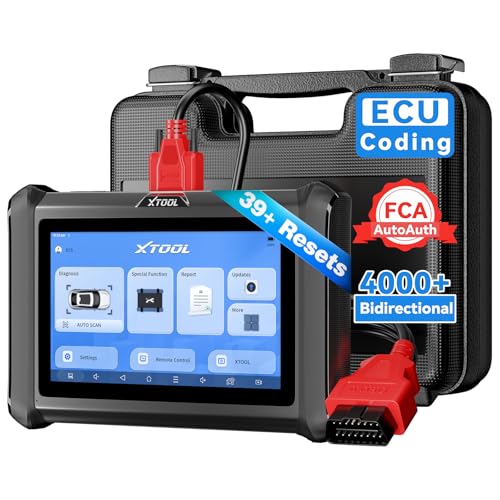
The XTOOL D7S at $398.05 adds ECU coding and PMI functions on top of standard bidirectional control, which is the kind of capability that starts to matter for module replacement and programming work rather than routine maintenance resets.
Not for: someone whose repairs stop at oil resets, ABS bleeds or basic sensor tests. That work is fully covered by the intermediate tier at half the price.
| Tool | Price | Capability | Best for |
|---|---|---|---|
| Launch Code Reader | $119.00 | Full system, bidirectional | First bidirectional tool |
| MUCAR 632 AI | $189.98 | ABS/SRS, 15 resets, active test, AI assist | Broad home-garage bidirectional coverage |
| TOPDON AD800BT V2.0 | $299.99 | Bidirectional, lifetime updates | Balanced capability and price |
| TOPDON ArtiDiag Pro | $379.99 | Bidirectional, ECU coding, 35+ services | Wide reset count plus coding |
| XTOOL D7S | $398.05 | Bidirectional, ECU coding, PMI | Module programming and coding work |
What makes a scan tool "bidirectional"?
A bidirectional scan tool can send a command to a vehicle module and receive confirmation, rather than only requesting and reading data. That two-way communication is what lets it run an ABS bleed sequence, cycle a cooling fan for testing, or retract an electronic parking brake caliper before pad replacement.
A read-only scanner, no matter how detailed its live data display, cannot perform any of those functions, because it never sends commands back to the vehicle. See our comparison of bidirectional versus read-only scanners for the full breakdown.
Which repairs actually require bidirectional control?
Electronic parking brake service on most modern vehicles requires retracting the caliper piston electronically before removing brake pads. ABS bleeding on vehicles with electronic modulators often needs a bidirectional bleed sequence to fully purge air from the hydraulic control unit. Steering angle sensor calibration after wheel alignment work commonly requires a scan tool procedure rather than a mechanical reset.
None of these are optional conveniences. Skipping the correct bidirectional procedure on these repairs can leave a safety system, such as ABS or electronic parking brake, in an incorrect or non-functional state.
- Electronic parking brake caliper service
- ABS hydraulic control unit bleeding
- Steering angle sensor calibration
- Injector or actuator active tests to isolate a fault
Do I need the most expensive tool on this list?
Only if your work regularly involves ECU coding or module programming. For the large majority of DIY brake, suspension and sensor work, the intermediate tier covers what you need at less than half the price of the coding-capable expert tier. Buying the most expensive tool because it sounds the most complete usually means paying for functions you will use once a year or never.
How is a bidirectional scan tool different from a professional shop scanner?
Every professional shop scanner is bidirectional, but not every bidirectional scan tool is built to professional-shop standards. The tools in this roundup cover the core bidirectional functions, resets and active tests, a home garage or independent technician needs. A professional scanner tier typically adds broader vehicle-brand coverage, J2534 module programming, and support for less common systems.
If your work stays within resets, active tests and common repair procedures, the tools here cover that ground without paying professional-tablet prices. Step up only once a specific job calls for programming or coding capability these tools do not list.
How we chose
This roundup is researched from published manufacturer specifications and listing capability claims across our catalog, not from hands-on testing of every tool. Every capability referenced here, bidirectional flags, reset counts, ECU coding claims, comes directly from what the product listing states, and prices match current listings.
Bidirectional capability is the dividing line in this roundup: a tool either lists the ability to send a command to a module (running an ABS bleed, cycling a fan, firing an injector on demand) or it does not, and we only included tools where the listing explicitly claims this.
Which specific bidirectional functions a tool supports on a specific vehicle varies by brand and model year even among tools that broadly advertise "bidirectional" or "active test" support. Always check the coverage list for your specific vehicle before assuming a particular procedure, such as steering angle calibration, is included.
Buying tips
What is the difference between a reset and an active test?
A reset clears a service reminder or recalibrates a system baseline, such as an oil-life reset or a steering angle sensor reset after an alignment. An active test commands a component to do something in real time, such as firing a fuel injector or cycling a relay, so you can confirm it responds correctly. Both require bidirectional communication; a read-only scanner can do neither.
Do I need ECU coding as a home mechanic?
Most home repairs, brakes, sensors, batteries, resets, do not require ECU coding. Coding becomes necessary when you replace certain control modules or program new keys, which is specialized work most DIYers encounter rarely if ever. Do not pay for coding capability unless a specific repair in front of you actually requires it.
How do I know a bidirectional command is safe to run?
Follow the vehicle manufacturer repair procedure, not just the scan tool prompt. A bidirectional scan tool gives you the ability to send a command, but the procedure, sequence and safety precautions still come from the vehicle service information, not the tool itself.
Is a $119 bidirectional tool as capable as a $400 one?
For core active tests and reset services on common vehicles, often yes. Where the gap widens is coverage breadth across less common brands, ECU coding, and module programming, all of which the higher-priced tools in this roundup add on top of the same core bidirectional foundation.
Other options worth knowing about
- XTOOL
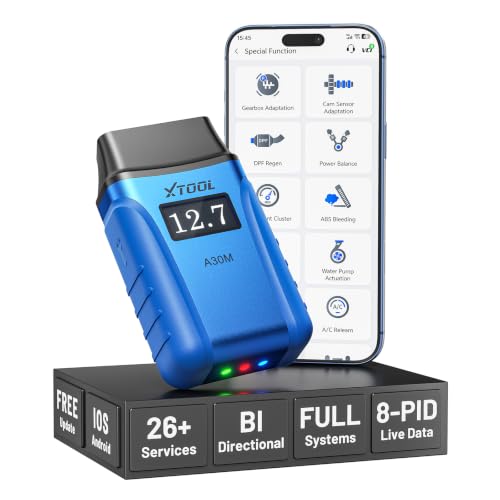
XTOOL A30M V2.0 OBD2 Scanner Diagnostic Tool, 26 Resets, All System
- full system
- service resets
$151.00 Check pricePrices change often - LAUNCH
2026 Upgraded LAUNCH Creader Elite V3.0 fit for GM,Bi-Directional Scan Tool
- bidirectional
$189.00 Check pricePrices change often - LAUNCH
LAUNCH Creader Elite X500 OBD2 Scanner for Mercedes-Benz
$189.00 Check pricePrices change often - LAUNCH
LAUNCH Creader Elite X500 for Honda OBD2 Scanner Bi-Directional Scan Tool
- bidirectional
$189.99 Check pricePrices change often - XTOOL
XTOOL A30M OBD2 Scanner Bluetooth, Bidirectional Scan Tool, 26 Resets
- bidirectional
- service resets
- wireless
$199.99 Check pricePrices change often - LAUNCH
LAUNCH Creader Elite X500 for GM OBD2 Scanner Diagnostic Tool Full System
- full system
$219.00 Check pricePrices change often



Common questions
What can a bidirectional scan tool do that a regular scanner cannot?
A bidirectional scan tool can send a command to a vehicle module, such as running an ABS bleed sequence, cycling a fan, or firing an injector for a test, and receive confirmation back. A regular read-only scanner can only request and display information; it cannot command anything.
Do I need a bidirectional scan tool to bleed ABS brakes?
On many modern vehicles with electronic ABS modulators, yes. A standard gravity or pressure bleed may not fully purge air from the hydraulic control unit, and the vehicle manufacturer procedure often calls for a bidirectional bleed sequence run through a scan tool.
Is a $119 bidirectional scan tool good enough for home use?
For most home-garage repair work involving common active tests and resets, yes. The gap to more expensive tools mainly shows up in coverage breadth across uncommon vehicle brands and in ECU coding or module programming, which most home mechanics rarely need.
What does ECU coding mean and do I need it?
ECU coding programs configuration data into a replacement control module so it matches the vehicle, needed for certain module replacements and some key programming. Most routine maintenance, brake and sensor repairs never require it, so it is only worth paying for if a specific job in front of you calls for it.
Can a bidirectional scan tool damage my car if used incorrectly?
Sending the wrong active test to the wrong module, or skipping steps in the manufacturer procedure, can leave a system in an unexpected or unsafe state. Always follow the vehicle-specific repair procedure rather than experimenting with bidirectional commands.
What is the difference between a reset service and an active test?
A reset clears a service reminder or recalibrates a baseline, such as an oil-life reset. An active test commands a component in real time, such as firing an injector, so you can observe its response. Both require bidirectional communication that a read-only scanner cannot perform.