Best compression testers
Quick answer
The AUTOWN Professional kit at $39.99 is the best compression tester for most DIYers because it includes a fluorescent 300 PSI gauge and two spark plug testers in a 13-piece set, covering compression and ignition checks in one kit.

AUTOWN Professional Compression Tester Kit with Fluorescent Gauge, 300 PSI Triple-Scale, 2 Spark Plug Testers, 13-Piece Set for Car, Truck, ATV & Small Gas Engines
For $39.99, the AUTOWN Professional kit includes a fluorescent, easy-to-read 300 PSI triple-scale gauge plus two spark plug testers across 13 pieces, giving a home mechanic both compression testing and a quick ignition check in one purchase.
Coverage varies by tool and by model year, so check a specific tool against a specific vehicle before buying.
The three tiers
Beginner: Best first compression tester
Who it is for: someone testing engine compression for the first time on a gas engine, on a tight budget
- Beginner pick
BETOOLL HW0130 8pcs Petrol Engine Cylinder Compression Tester Kit Automotive Tool Gauge
$19.99 Check pricePrices change often
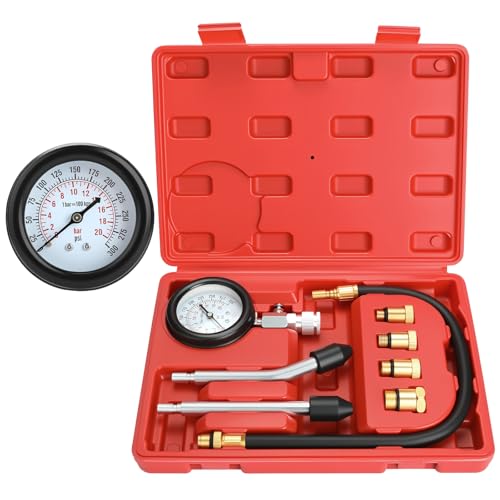
The BETOOLL HW0130 at $19.99 is an 8-piece compression tester kit with the adapters needed to test a typical gasoline engine, which covers a one-time or occasional diagnostic check without a large investment.
Not for: anyone testing a wide range of engine types regularly, since the adapter selection is more limited than the larger kits in this roundup.
Intermediate: Best value compression tester kit
Who it is for: a DIYer who wants a durable gauge and a spark plug tester included for a broader diagnostic check
The AUTOWN Professional kit at $39.99 includes a fluorescent 300 PSI triple-scale gauge, which is easier to read than a standard analog face, plus two spark plug testers across 13 pieces for cars, trucks, ATVs and small gas engines.
Not for: someone who needs a shop-grade Bourdon tube gauge built for continuous professional use rather than occasional home use.
Expert: Best compression tester for durability and accuracy
Who it is for: a technician or serious DIYer who wants a shop-grade gauge built to hold accuracy through repeated professional use
- Expert pick
OTC 5605 Deluxe Compression Tester Kit for Gasoline Engines
$126.99 Check pricePrices change often
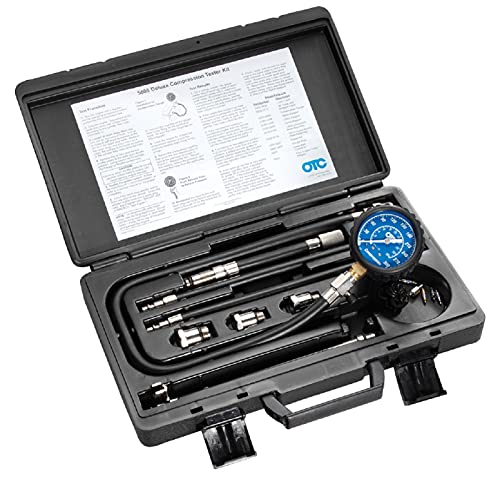
The OTC 5605 Deluxe Compression Tester at $126.99 is built for gasoline engines with the kind of gauge construction associated with shop-duty tools, aimed at technicians who test compression regularly rather than occasionally.
Not for: a DIYer testing compression once or twice a year. The intermediate kit performs the same core test for less than a third of the price.
| Tester | Price | Capability | Best for |
|---|---|---|---|
| BETOOLL HW0130 | $19.99 | 8-piece kit, standard gauge | One-time or occasional use |
| AZUNO Digital | $27.99 | Digital gauge, 200 PSI, adapter + hose | Digital readout preference |
| AUTOWN Professional | $39.99 | Fluorescent 300 PSI gauge, spark plug testers | Compression plus ignition check |
| Mityvac MV5530 | $86.68 | Bourdon tube gauge, motorcycle/marine adapters | Motorcycle, marine and small engines |
| OTC 5605 Deluxe | $126.99 | Shop-grade gauge | Frequent or professional use |
What does a compression test actually tell you?
A compression test measures the maximum pressure each cylinder builds during cranking, which reflects how well the piston rings, valves and head gasket are sealing combustion pressure. Low compression in one cylinder relative to the others points toward a mechanical problem inside that cylinder, such as a worn ring, a burnt valve, or a blown head gasket.
This test cannot diagnose an electrical, fuel delivery or sensor problem; it is strictly a mechanical health check of the cylinders themselves.
What compression reading is considered normal?
There is no single universal number, since normal compression varies by engine design and compression ratio. What matters most in a home-garage test is consistency across cylinders: most manufacturers consider a spread of more than about 10 to 15 percent between the highest and lowest cylinder reading to be a warning sign, even if every individual number looks reasonable in isolation.
- Compare cylinders to each other, not just to a single "normal" number
- A consistently low reading across all cylinders can point to a timing issue rather than a single bad cylinder
- A very low reading in one cylinder, with adjacent cylinders also low, can suggest a head gasket leak between them
Is a digital or analog gauge better?
A digital gauge gives a precise numeric readout that is easy to read at a glance, while a quality analog gauge, particularly a fluorescent or Bourdon tube style, remains accurate and durable through repeated use without needing batteries. Either works fine for accurate compression testing; the choice mostly comes down to personal preference and how often the tool will be used.
How is a compression test different from a leak-down test?
A compression test measures peak cylinder pressure during cranking and tells you that a cylinder is weak, but not why. A leak-down test pressurizes a cylinder with compressed air at top dead center and listens for where that air escapes, whether through the intake, the exhaust, or past the piston rings into the crankcase, which pinpoints the specific failure point a compression test alone cannot identify.
Many technicians use a compression test first as a quick screening tool, then follow up with a leak-down test only on cylinders that showed a weak or inconsistent reading, since the leak-down test requires more setup and time to perform.
How we chose
This roundup is researched from published manufacturer specifications and listing descriptions across our catalog, not from hands-on testing or gauge calibration verification of every unit. Gauge type, PSI range and included accessories referenced here come directly from what each listing states.
A compression tester's core job (measuring peak cylinder pressure during cranking) is the same across every price point; what changes with price is gauge readability, durability under repeated use, and what adapters or extra tools, like spark plug testers, are included in the kit.
Compression specifications vary by engine, so no compression tester tells you a pass or fail number on its own. Always compare a reading against the manufacturer specification for your specific engine, and compare the readings across all cylinders relative to each other, which often matters more than the absolute number.
Buying tips
What PSI range do I actually need?
Most gasoline passenger vehicle engines fall well within a 0 to 200 PSI test range, so a 200 or 300 PSI gauge covers the overwhelming majority of home-garage testing. Higher PSI ranges matter more for certain diesel or high-compression applications, which is worth checking against your specific engine before assuming any kit works.
Why do some kits include a spark plug tester?
A spark plug tester checks for adequate ignition spark, which is a separate but related diagnostic step when an engine runs rough or a cylinder is misfiring. Combining a compression check with a spark check in one kit lets you rule out or confirm both a mechanical and an ignition cause in a single session.
How do I know if my adapter set fits my engine?
Most kits include several thread sizes to cover common spark plug hole diameters across different engines, but always verify the included adapter sizes against your engine's specification before assuming universal fit, particularly on less common engine types like motorcycles, ATVs or older vehicles.
Other options worth knowing about


Common questions
What is a normal compression test reading?
There is no single universal number, since it depends on the specific engine's compression ratio and design. What matters more than the absolute number is consistency across cylinders; a spread greater than roughly 10 to 15 percent between the highest and lowest cylinder is generally considered a warning sign.
Can I do a compression test myself?
Yes, a compression test is a common DIY diagnostic procedure that requires removing spark plugs, disabling the ignition and fuel system per the tool instructions, and cranking the engine while the gauge reads each cylinder in turn. It requires basic hand tools and following the kit instructions carefully.
Do I need a different compression tester for a diesel engine?
Often yes. Diesel engines run much higher compression ratios than gasoline engines and typically need a gauge rated for a higher PSI range along with diesel-specific adapters. Check that a compression tester explicitly supports diesel engines before assuming a gasoline-rated kit will read accurately.
What does low compression in one cylinder mean?
It usually points to a mechanical sealing problem specific to that cylinder, such as worn piston rings, a burnt or leaking valve, or a head gasket issue. A compression test alone identifies which cylinder is affected; further teardown or a leak-down test is usually needed to pinpoint the exact cause.
Why do some compression tester kits include a spark plug tester?
Because a rough-running or misfiring engine can be caused by either a mechanical compression problem or an ignition spark problem, and testing both in one session, using the included spark plug tester alongside the compression gauge, helps narrow down the cause faster.